What Is Harkat in Kathak? Meaning, Technique, and Expression
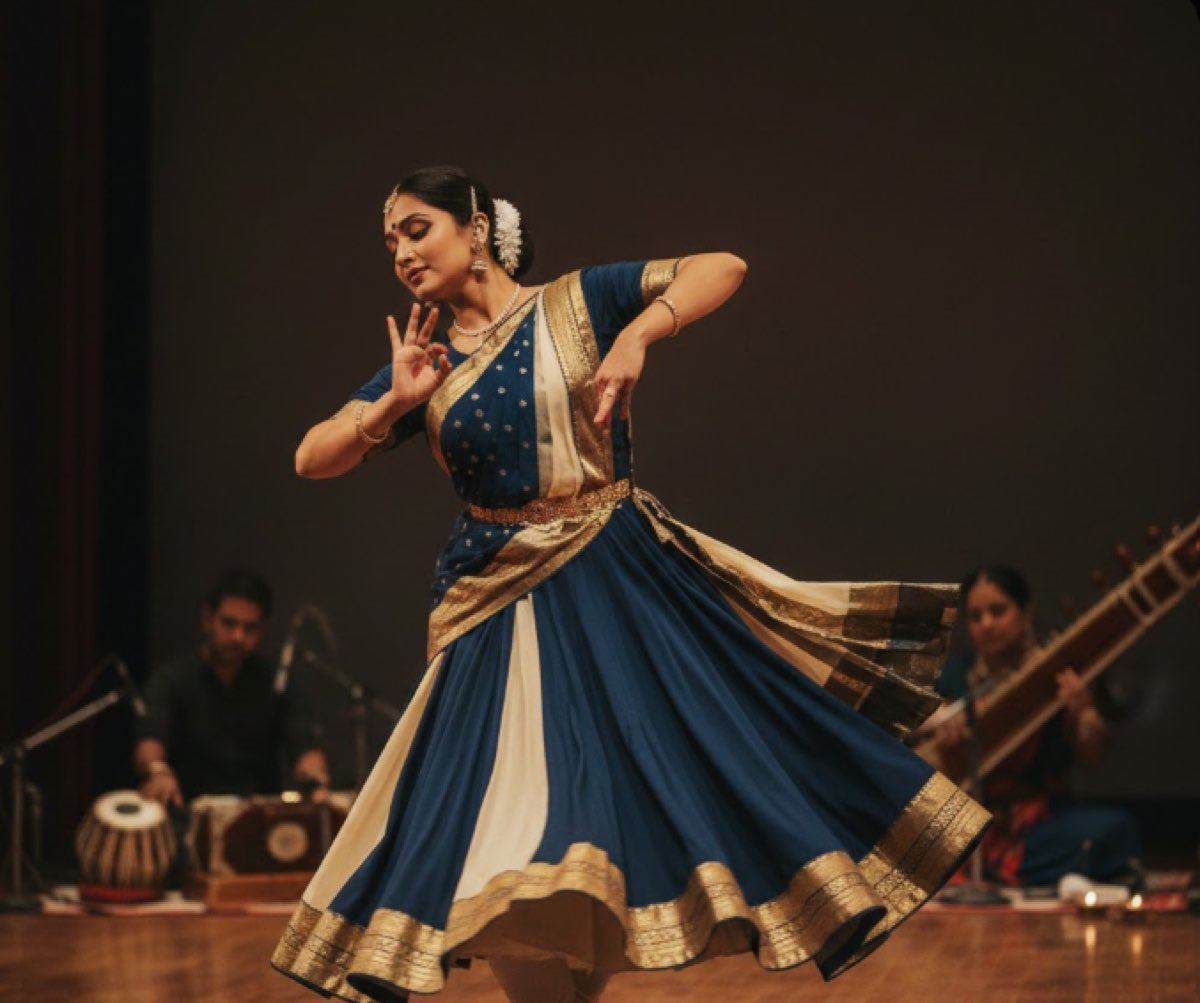
Harkat is the silent poetry between beats, revealed in how a movement unfolds. It is this subtle “how” that transforms Kathak from steps into feeling.
Kathak may well be introduced in terms of those most striking components: lightning-fast footwork, geometrically complex time cycles, and whirling chakkars that appear to suspend the laws of gravity altogether. Yet, suspended between those strokes of brilliance, there is, in fact, something far quieter and subtler, and every bit as essential: 'harkat.' If "tatkar" is the pulse and "layakari" is the intellect
Harkat is not a dance movement or a systematized skill. Harkat is a sensibility. It pertains to the aesthetic of movement and gestures that make Kathak ever so fluid and expressive. One could almost say that harkat is that quality of motion which renders movement expressive.
Why Harkat Matters in Kathak Dance
In general usage, harkat means "movement" or "action." In the context of Kathak dance, however, harkat holds a much deeper artistic meaning. It means the subtle turn of the wrists, the arc of an arm, the lift of the torso, and the fluid transition between movements. It is all about the beauty in the transition, the implication rather than the exhibition.
Unlike hastas or mudras, harkat cannot be strictly codified. Its realm exists in the realm of interpretation. Two choreographed pieces done by two different dancers who execute the same steps will have the same harkat yet will be set in vastly different internal landscapes.
Harkat in Nritta vs Nritya: Understanding the Difference
There is a traditional division of kathak between “nritta,” or purely dance, and “nritya,” or expressive dance. Harkat is present in both areas, it works quietly to shape grace, clarity, and meaning.
In nritta by itself, harkat is subdued. The focus is on layakari, tatkar, and rhythmic clarity. In this context, harkat functions as a refining force, smoothing transitions and ensuring that the dance does not become mechanical.
In "nritya," however, harkat develops fully. With "thumri, bhajan, or ghazal," it assumes a life of its own. A tilt of the wrists can express yearning, a wave of surrender, or a silence of controlled stillness, which can often express more than action. In this, harkat expresses emotions where words fail.
Lucknow, Jaipur, Banaras: Gharanas and the Language of Harkat
The importance and style of harkat will differ according to Kathak gharanas and depending upon their philosophic attitudes.
The Lucknow gharana, formed under the patronage of the Awadh courts, holds nazakat (delicacy) and abhinaya in paramount importance. In this style, ‘harkat’ is the focus. The movements are curved, fluid transitions are involved, and expression is achieved with an undertone of subtlety. The performer seems to be floating on stage as if moved by feeling as well as rhythm.
On the other hand, the Jaipur gharana is based on power, speed, and complexity of rhythms. Harkat emerges, but it is judicious and useful. Power and clarity come before softness, and ornamentation is held well in check to accent the tala.
Banaras gharana finds itself in a mid-position, balancing expression with pugnacity. The tala in Banaras is translated with religio-spiritual fervor, due to the spiritual background prevalent in this particular locale.
In other words, the understanding of harkat involves the understanding of lineage. It is not merely learned through techniques, but through observation, absorption, and submersion in the stylistic worldview.
Training Harkat: Musicality, Breath, and Transitions
One of the greatest qualities of harkat is its connection to music. Footwork is clearly attuned to music’s rhythmic structure, but harkat is attuned to melody, mood, and textures of music. It is the reflection of the glide of “raaga,” the “curve of the vocal,” or the “softness of the bol,” and “the echo of the note itself.”
A dancer with a well-developed harkat does not only keep the rhythm, but they also listen profoundly. Their movements will be attuned to the smallest changes in rhythm and feeling, allowing the rhythm to breathe with the music. In this way, there is an intimate conversation that is taking place between the dancer, the musician, and the audience that can be felt, even though it is not understood.
How to Train Harkat: Refinement, Restraint, Presence
Since harkat is not standardized, it is also considered the most difficult part of Kathak to teach. It cannot be perfected by merely practicing it repeatedly. Although practicing footwork and perfecting turns requires practice, harkat requires endurance, maturity, and introspection.
Traditionally, the practice of harkat is:
- Observing One’s Guru Carefully
- Performing the slow movements with awareness
- Enhancing control of breath and torso functions
- **Developing emotional presence **
Young dancers tend to overdo with too much embellishment, too much softness, too much movement. Experience brings restraint.
Good harkat is sparing; it shows only as much as necessary.
The Difference Between Movement and Meaning in Kathak
Today, in many performance venues where speed and spectacular elements play such big roles, harkat is in danger of being misunderstood or simply overlooked. "Instead, it might be confused with purely decorative movements and not expressive ones. Yet, it is just these expressive elements that separate a technically accomplished dancer and an artist.
A dense performance of harkats draws the viewer within. It is a style of Kathak where there is a lull for the viewers to experience rather than observe. This is what makes Kathak accessible even in bigger platforms.
Why Harkat Matters Today: Kathak’s Anchor in a Global Age
In this age of globalization of dance and fusion forms, harkat holds Kathak grounded to its aesthetic origins. It maintains the form’s lyrical quality to ensure that virtuosity is not at the expense of vulnerability.
For those who dance, the importance of harkat is that it is where the skill is not merely in the complication but in the subtlety. For those who watch, it is the element that brings impact as it is the emotional link that translates Kathak into something more than just rhythm.